...
(f) What are the preparation needed for DSA?
It is difficult to prepare for the test. However, it is critical to prepare for the Interview. As explained earlier, there are many GEP students applying for the same DSA, are well trained for the interview by their schools. If your kid is not from GEP program, you may want to consider to seek help. That's the reason training for DSA interview is not something new, per this report from todayonline.
Let me list down two DSA interview trainings that I know:
(1) Speak Venture - I engaged Speak Venture for my son. Gary and Sabrina teach very well.
(2) Jackeline Carter Centre for Public Speaking - I know about them after engaging Speak Venture. They have a lot of good information on their website. They are generous to share. Check out those free advises.
(3) There are others that look credible from their website. However, many of them do not give much information on the web. So, hard to tell whether their program are effective.
(g) I don't want to spend that kind of money for DSA interview training, what should I do?
There are a lot of information nowadays. Check the following out:
(1) J. Carter's blog
(2) DSA Interview Blog
(or Google for sample questions if you like)
I would say, teach your kids to treat DSA interview like Job interview, He/She should sell himself/herself. Practice explaining why the school should select you. Prepare your credentials well. But one point to remember is that some DSA interviews are group interviews. Make sure the candidate pay attention when others are answering, and they should fight for the chance to answer. Get few friends together, conduct your own trial interview. Record down the interview and show the students how they perform. This step is very critical. Make good use of your mobile phone camera because it will make a lot of different when the kid see their own expression/mistakes.
(h) Biggest Misconception about selection criteria
Each school may have different criteria looking for talents that they want. I know HCI more because I know at least 3 persons who managed to get into HCI through DSA. What I can say is that they do not select students who have the best results. Interview plays an important role. One common point I see in all the 3 successful candidates is that all of them are good at at least one thing other than studies. So, if you have one special skill, make sure you go and take part in competition and show good track record. Do not back off from applying to HCI (can't say so for RI) even if you do not have the best result. However, do consider whehter HCI is suitable for you.
(i) When should I start preparing for DSA?
I would say, the preparation should start from Primary 4. Why? You need time to join those competitions. DSA requires you to show results from P4-P6. Also, you should start preparing for DSA during P5 by visiting all those schools that you are interested in.
Good luck to you! Before you apply, please revisit point (d) in part 1.
Showing posts with label academic. Show all posts
Showing posts with label academic. Show all posts
Friday, December 4, 2015


Wednesday, December 2, 2015
What I did not know about DSA - Part 1 General Information
Direct School Admission (DSA) was very new to me 6 months ago. Here are what I have found out:
(a) What is DSA?
Direct School Admission (DSA) is a program in Singapore introduced in 2004 for students who are studying Primary 6 or Secondary 4 to be guaranteed a place in a Secondary School or Junior College respectively. You may check out more from MOE website. I benefited a lot from the free eBook provided by Koobits.com. For those of you who know little about DSA, those information are very helpful.
(b) What are the test?
Some schools such as Raffles Institute (RI) requires candidates to take Generally Ability Test. Some school such as Hwa Chong (HCI) conduct their own selection. In short, DSA needs preparation. Some parents even attempt to down load past exam papers for GAT or the secondary school's exam.
I find that preparing for those written exam is a waste of time. In fact, my initial thought is that DSA may be additional trouble or preparation. So, why taking it? Because of the fact illustrated in (c) below.
(c) Most top school offers half of the allocation through DSA
At least half of the allocation of top school like RI and HCI are offered through DSA. So, not applying for DSA would mean giving up good opportunity.
(d) Important considerations about DSA
Please apply the school you want, and not the school you can get. For example, many parents in my son's school get their son to apply for Catholic High School (a good school, but not top two at the point of writing). Some how, they were lucky that they did not get a place because when their sons get top score, almost all of them applied for RI and HCI. Good for them. I believe they will regret if their application was successful.
But, DSA application may work the other way, for example, you get into a good school through DSA but the PSLE result is not good enough to qualify for the school. So, think through this point well.
(e) Fierce competition from GEP students
Many students from Gifted Education Program (GEP) will apply through DSA. Generally, the GEP students are strong candidates. However, if your kid is from normal stream, please take effort to assure him/her that while it is true that GEP students are strong candidates, that does not mean they are definitely better and there is no chance for normal stream students.
But let me prepare you first, the competition is NEVER fair! Why? Most of the students from GEP are prepared well by the school for the DSA interview, but most normal stream students are not prepared at all from our experience.
For example, a training provider told me that they did training for 10 lessons for some GEP schools!!!! Many GEP students whom I meet told me the same thing. The hard truth is, due to this, normal stream student may be at a disadvantage position, because it makes a lot of difference whether one know or does not know how to handle interviews. Do not forget, we are talking about 12 year old kids here.
.... to be continued
Thursday, January 2, 2014
IQ Math for PreSchool


Let me say this. I believe some of the questions may be too difficult for 4 years old, or even 6 years old. However, some of the questions are doable. I have to admit that I am quite surprised with what kids (my daughter and her classmate) can do. I won't recommend this book to all parents, but if the kids have interest in this area, worth a try. The questions may be similar to olympiad math questions. Honest, I don't think every kid will like this book.
Some questions are really very difficult. How did I coach my kids? Well, I explained those difficult questions, give clues. With that, my daughter can do many of the questions. If she cannot do the question, I told her that it's OK and I will teach her how to do the questions. Sometimes, I have to look at the answer too. :-) She even brought this to school and "finished" the book on her own but she left it blank if she did not know the solution.
If your kids like Maths, show this book to them and see whether they like the book.
P/S: Thanks the author for writing this book.
Sunday, September 2, 2012
Start to Read, early reading program from School Zone
I seldom see products from the publisher School Zone in any of the local Singapore or Malaysia bookstore, but I came across the material of "Start to Read Early Reading Program" last week at Popular Bookstore, Singapore. Check out the following links to learn about the products.


The price is about SGD10 per set, comparable with the price in US. However, Popular Bookstore is having a discount of 20%- 25%. Below are the 3 sets that I purchased.

I started using the level 1 book today. Like all other sets, each set comes with 5 reader books, 1 CD, 1 activity comprehension book and a parental guide.

I like the approach taken in this reading program, where the kids are supposed to listen to the audio CD first, to sharpen up the listening skill. I discussed the story with my 5 years old. My daughter could not get some of the words when we listened to the CD, but that does not matter. I could not get some of those words too. :-) But I can tell that roughly, she knows what's the story about. It's my hope that she can get used to the native pronunciation through this listening exercise.
Then I let her read aloud and then let her listen to CD per instruction. Again, the audio CD is very helpful for non-native speaker like me. After reading the books, we listened again to the CD. This time, we could almost gets everything. One more good point, the books are colorful with interesting graphic and certainly my 5 years old loves this very much.

I was wondering how to ask her more detailed questions... but the comprehension book saved my day. The comprehension book carries a few simple questions related to the stories.

If you are interested, go and take a look at Popular Bookstore now! If you read this much later date, well, you can always buy from Amazon. From my experience, the shipping is not that expensive.
Sunday, August 5, 2012
Another Good Math Book
My son loves Math. He likes challenging questions. So, we always find Olympiad Math book that provides challenging questions for him to think. We both think that this book has very high quality questions.
 For example, one of questions is now my favorite question. If I have to conduct interviews for engineering positions, this will become one of my interview questions. The question is something like this:
"Banana Kingdom uses only two types of coins, i.e. 5-cent coin and 21-cent coin. Because of this, some numbers cannot be paid using only these two types of coins. For example, 6 cents, 7 cents, 22 cents.... etc. What is the biggest number that cannot be paid by using these 2 types of coins? Assume that there are indefinite supply of coins"
At a first glance, I would think the answer is infinite, but that's wrong. Answer should be 79. This question is difficult, but very doable.
To me, this book is among the best for this reason. Many people cannot do this just because they are impatient. If I show them and get them to list down the numbers that can be paid by those coins, most people can get the answer. My son understands after I show him the answer. However, he does not know how to explain this well to others. I encourage him to do so to sharpen his skill. Many of the questions here need analytical skill. Worth considering if you kids like Maths. I would like to thank the author, Ms Loh Cheng Yee, for her good work. I think Ms Loh's books are pretty good.
By the way, for those not familiar with Singapore, GEP stands for Gifted Education Program. This program is designed for top students in Singapore. I heard that some parents send their kids to tuition with hopes that they get into this program. I discourage such attitude because the kids will suffer and will drop out. Similarly, many parents buy Olympiad Maths book for their kids and even pay for expensive Olympiad Math Training with the hope that their kids will win in Olympiad Math competition. I disagree with such attitude too. I hope you don't do buy this book with such intention.
For me, I encourage my son to do this as a hobby. If he does not know the answer, he will look at the answer provided at the back and figure out how to get the answer. I am glad that my son enjoy thinking and analyzing. Usually he will share with me those difficult questions.
It is my hope that this book will help me to train my son to think and to analyze.

"Banana Kingdom uses only two types of coins, i.e. 5-cent coin and 21-cent coin. Because of this, some numbers cannot be paid using only these two types of coins. For example, 6 cents, 7 cents, 22 cents.... etc. What is the biggest number that cannot be paid by using these 2 types of coins? Assume that there are indefinite supply of coins"
At a first glance, I would think the answer is infinite, but that's wrong. Answer should be 79. This question is difficult, but very doable.
To me, this book is among the best for this reason. Many people cannot do this just because they are impatient. If I show them and get them to list down the numbers that can be paid by those coins, most people can get the answer. My son understands after I show him the answer. However, he does not know how to explain this well to others. I encourage him to do so to sharpen his skill. Many of the questions here need analytical skill. Worth considering if you kids like Maths. I would like to thank the author, Ms Loh Cheng Yee, for her good work. I think Ms Loh's books are pretty good.
By the way, for those not familiar with Singapore, GEP stands for Gifted Education Program. This program is designed for top students in Singapore. I heard that some parents send their kids to tuition with hopes that they get into this program. I discourage such attitude because the kids will suffer and will drop out. Similarly, many parents buy Olympiad Maths book for their kids and even pay for expensive Olympiad Math Training with the hope that their kids will win in Olympiad Math competition. I disagree with such attitude too. I hope you don't do buy this book with such intention.
For me, I encourage my son to do this as a hobby. If he does not know the answer, he will look at the answer provided at the back and figure out how to get the answer. I am glad that my son enjoy thinking and analyzing. Usually he will share with me those difficult questions.
It is my hope that this book will help me to train my son to think and to analyze.
Monday, October 3, 2011
Teaching Hooked on Phonics
This is another post about teaching the Hooked On Phonics.
Below is a video clip taken during one of her revision lessons.
Here are a few guidelines that I follow. I am sure there are better techniques, if you know one, please let me know.
1) Conduct short lessons. In my case, I will stop when my daughter get bored, usually about 10-15 minutes.
2) Praise a lot... I know, I lose patient too, as you can see in video clip. And I did not praise as much as I am supposed to do.
3) Play games.. Hide and Seek Word Game. She finds a word from one page, sometimes, compete with her brothers.
4) Hint my daughter the phonetic sound of the first letter..
5) A bit unusual, but I played spelling game.
6) Practice often.. I print out one copy and let her revised whenever she feels like to do.
I am thankful that my son benefited from this course. I hope that I can repeat this with my daughter. I am encouraged that many friends use this too after I show them the products, I hope that they will be successful too.
My daughter is glad that I shared this with her friends. She seems motivated to read because her friends are reading the same thing!
Below is a video clip taken during one of her revision lessons.
Here are a few guidelines that I follow. I am sure there are better techniques, if you know one, please let me know.
1) Conduct short lessons. In my case, I will stop when my daughter get bored, usually about 10-15 minutes.
2) Praise a lot... I know, I lose patient too, as you can see in video clip. And I did not praise as much as I am supposed to do.
3) Play games.. Hide and Seek Word Game. She finds a word from one page, sometimes, compete with her brothers.
4) Hint my daughter the phonetic sound of the first letter..
5) A bit unusual, but I played spelling game.
6) Practice often.. I print out one copy and let her revised whenever she feels like to do.
I am thankful that my son benefited from this course. I hope that I can repeat this with my daughter. I am encouraged that many friends use this too after I show them the products, I hope that they will be successful too.
My daughter is glad that I shared this with her friends. She seems motivated to read because her friends are reading the same thing!
Friday, September 30, 2011
Socratic Approach for Kids?
My learning in US and Japan particularly after Master course is largely based on Socratic Approach. Wikipedia explains that this is a form of inquiry and debate between individuals with opposing viewpoints based on asking and answering questions to stimulate critical thinking and to illuminate ideas. To young children, I think this may be called "proactive learning". To me, in the context of training people at work place is "I teach you one thing, you have to teach me back ten in return".
One major contrast to this approach is our commonly seen spoon feed teaching method. In this method, teachers or parents tell kids everything on what they should know. Notes are prepared, and students are expected to do well in exams after reading the notes, period! I have gone through this and I have seen how spoon feeding type of education limits and slows down learning process (**see my comment). Just ask ourselves how can one teach in the limited hours of lesson per week? Compared to another students who keen learning by himself, I would think the later learns better.
The question for me is how do we encourage proactive learning? How do we teach young kids to learn by themselves? Call me lazy or whatever, I dislike taking care of my kids's spelling test. I made it clear that it's his responsibility and he managed that very well. Whenever he asked me meaning of a new words, I seldom give him the answer and asking him to check dictionary. Sometimes, I tell him to "google" the answer. I think all these are part of proactive learning education from me to him! Socratic approach requires more than that, students are supposed to critically think about what they learned. In contrast, some teachers told me that if they asked students to look up dictionary, they are wasting lesson time! The expectation of parents is no dictionary in classroom! Wow! I am surprised.
I have a friend whose daughters were both pursuing medicine under scholarships. I asked him how did he do that.. His answer to me was, "do nothing!". Interesting answer... but I think that answer has a lot of wisdom in it. It's not easy to do nothing, especially if you see your kids get bad marks from one exam, right?
What else can I do better on this? I don't know. Perhaps following my classmate's way is the best! What do you think? Please share.
One major contrast to this approach is our commonly seen spoon feed teaching method. In this method, teachers or parents tell kids everything on what they should know. Notes are prepared, and students are expected to do well in exams after reading the notes, period! I have gone through this and I have seen how spoon feeding type of education limits and slows down learning process (**see my comment). Just ask ourselves how can one teach in the limited hours of lesson per week? Compared to another students who keen learning by himself, I would think the later learns better.
The question for me is how do we encourage proactive learning? How do we teach young kids to learn by themselves? Call me lazy or whatever, I dislike taking care of my kids's spelling test. I made it clear that it's his responsibility and he managed that very well. Whenever he asked me meaning of a new words, I seldom give him the answer and asking him to check dictionary. Sometimes, I tell him to "google" the answer. I think all these are part of proactive learning education from me to him! Socratic approach requires more than that, students are supposed to critically think about what they learned. In contrast, some teachers told me that if they asked students to look up dictionary, they are wasting lesson time! The expectation of parents is no dictionary in classroom! Wow! I am surprised.
I have a friend whose daughters were both pursuing medicine under scholarships. I asked him how did he do that.. His answer to me was, "do nothing!". Interesting answer... but I think that answer has a lot of wisdom in it. It's not easy to do nothing, especially if you see your kids get bad marks from one exam, right?
What else can I do better on this? I don't know. Perhaps following my classmate's way is the best! What do you think? Please share.
Sunday, September 18, 2011
Teaching My Girl - Hooked on Phonics -- using spelling approach.
This is about the Hooked On Phonics that I introduced quite some time ago. I am glad that I used this set for my son because without my supervision, he managed to get 100% almost all the time in his spelling test. I have started this for my daughter 6 months ago.. We make some progress, but we also see some challenges.
My son's characteristic is different from my daughter. My son, from the very beginning, learned how to pronounce by looking at the phonetic sound of each letter. My daughter, on the other hand, memorized the phonetic sound very quickly. She tends to memorize pronunciation of each words without looking at phonetic sound at all. She just read without really looking at the words.
This gave us a hard time because there's always a limit, and she can't pronounce new words that she never learns. By right, using the Hooked on Phonic Material, she should be able to read new wordslike "Magic". For your information, the Hooked on Phonics material teaches basic phonetic sounds, and put words together that children can read words in stories book by on their own.
Her progress slowed down... In order to encourage her to look at each phonetic sounds, I play "spelling game" with her. She likes to write on white board. So, when we installed a new book cabinet, I added in "my designs" having white boards for her to write on. (Actually copied from a blogger friend cum colleague).
Here you go... see her happy face and the confidence in her! She can spell many words. Like many other kids, she tends to write in mirror... for example, mixing up "b" and "d", "p" and "q" etc. But overall she does very well. Whenever she can't spell a word, I guided her. And she tried to guess the phonetic sounds.
 1st half...
 2nd half...
Note : Although I corrected her, I never emphasis on what she did wrong, only on what she did right. Again, the power of singing praises.
After few rounds of this spelling game. Now, she can read new words... "Daddy, I never learn this word but I can read!" I am very glad. "Different strokes for different folks".. This is another management technique learned at work applied in parenting.
The only obstacles now is discipline. Right now, I only conduct the lessons as and when both of us feel like to do so, and sometimes, I realized that the last lesson was actually 3 weeks ago!
I will improve on that and I hope my daughter can read and be ready for school by 7 years old. Wish me luck, OK?
My son's characteristic is different from my daughter. My son, from the very beginning, learned how to pronounce by looking at the phonetic sound of each letter. My daughter, on the other hand, memorized the phonetic sound very quickly. She tends to memorize pronunciation of each words without looking at phonetic sound at all. She just read without really looking at the words.
This gave us a hard time because there's always a limit, and she can't pronounce new words that she never learns. By right, using the Hooked on Phonic Material, she should be able to read new wordslike "Magic". For your information, the Hooked on Phonics material teaches basic phonetic sounds, and put words together that children can read words in stories book by on their own.
Her progress slowed down... In order to encourage her to look at each phonetic sounds, I play "spelling game" with her. She likes to write on white board. So, when we installed a new book cabinet, I added in "my designs" having white boards for her to write on. (Actually copied from a blogger friend cum colleague).
Here you go... see her happy face and the confidence in her! She can spell many words. Like many other kids, she tends to write in mirror... for example, mixing up "b" and "d", "p" and "q" etc. But overall she does very well. Whenever she can't spell a word, I guided her. And she tried to guess the phonetic sounds.


Note : Although I corrected her, I never emphasis on what she did wrong, only on what she did right. Again, the power of singing praises.
After few rounds of this spelling game. Now, she can read new words... "Daddy, I never learn this word but I can read!" I am very glad. "Different strokes for different folks".. This is another management technique learned at work applied in parenting.
The only obstacles now is discipline. Right now, I only conduct the lessons as and when both of us feel like to do so, and sometimes, I realized that the last lesson was actually 3 weeks ago!
I will improve on that and I hope my daughter can read and be ready for school by 7 years old. Wish me luck, OK?
Sunday, June 5, 2011
Flash Card (2)... The Alternative Way
If flash card is not your cup of tea, perhaps you can try the following CD or DVD from Dr. Titzer. My wife received the VCDs from a close friend. She bought the disc in Singapore. I notice that the VCD or DVD are very popular in Singapore and available in major department store, book shops, and even toy shops. Certainly, you can buy from the following website. For those in US, below is a link to Amazon. I suspect that the product sold in US is different from those sold in Singapore and Australia because the US version is specially made for US following US's pronunciation and spelling. I think it's safer to buy from the region where you are from. I am not sure about this and it's best to check before you make your purchase. (P/S: I read that Dr Titzer is from California. )
I am not sure whether the DVD is same as what I bought but the author, the title, and contents look exactly the same.
From the experience of many people, including myself, the problem with this DVD/VCD is that children tend to watch TV and not interested in flash cards. So, you would probably have to choose either the DVD or flash cards. Perhaps start with flash cards first if you are not sure. I would say the product from Dr Titzer is quite good, it shows the words, the correct pronunciations and talks about many facts about the words. This is exactly what Dr Glenn Doman recommended from what I read. Except that it's not few second per session. Both my kids love the VCDs from Dr. Titzer
I have to admit that I do not have the discipline to flash the cards 3 times a day, 5 seconds per session. Many of the cards are lying there in the store room untouched. I confess that I did not make full use of the cards that I bought. I used the cards with my son, but gave up after 1 year, and I did not really use it on my daughter. One main reason is that my daughter dislike English flash cards. She likes Chinese flash cards. She can read many words now. I did not really flash but instead teaching her to read at the age of two. I think this has to do with a lot of praises and encouragement.

The following are video clips showing my daughter enjoying reading words. One taken in 2009 and another one taken recently. I would think she enjoys reading those cards, right?
2009 Video Clip - 2 years old
Please note that in 2011 clip, I am playing "Pile Up" game with her. The "Pile Up" game is what I learned from the Hooked on Phonic material. If she knows the word, she can keep it, else I will keep the card. Also, at the end of the clip, I was teaching her new words. Shameful to say, I stopped quite a while in 2010... :-( If I continued to have the discipline, she would know much more words today.
2011 Video Clip - 4 years old
In Penang, I saw a "tuition center" (located in Island Glades) teaching those flash cards. In my opinion, this is very wrong. Having read the book, I know that the concept of "tuition classes" using flash cards is wrong to begin with. The idea is to flash, 3 times a day, less than one second per card. How on earth one uses these flash cards for 1 hour per week and charged parents for money? Dr Glenn Doman said that one should flash the cards 3 times and each sessions should be at least 2 hours apart. If you are considering them, check out the point I mentioned above with them. Even using VCDs might be better.
Lastly, please allow me to share few common mistakes in using flash cards from my experience and from my reading from the book.
(1) Flash cards are to be flashed. So, please do not put beside baby cot for baby to stare at.
(2) If you start at young age, please do not have expectation. If parents have high expectation it will kill the interest to learn.
(3) Must have strong determination and discipline to do every day...
(4) Pay attention to the size of wordings, color and pictures. Should be 2-3 inches with red color.... if you purchase from "wet market" or low cost item... then make sure the size is suitable for your child.
I am not sure whether the DVD is same as what I bought but the author, the title, and contents look exactly the same.
From the experience of many people, including myself, the problem with this DVD/VCD is that children tend to watch TV and not interested in flash cards. So, you would probably have to choose either the DVD or flash cards. Perhaps start with flash cards first if you are not sure. I would say the product from Dr Titzer is quite good, it shows the words, the correct pronunciations and talks about many facts about the words. This is exactly what Dr Glenn Doman recommended from what I read. Except that it's not few second per session. Both my kids love the VCDs from Dr. Titzer
I have to admit that I do not have the discipline to flash the cards 3 times a day, 5 seconds per session. Many of the cards are lying there in the store room untouched. I confess that I did not make full use of the cards that I bought. I used the cards with my son, but gave up after 1 year, and I did not really use it on my daughter. One main reason is that my daughter dislike English flash cards. She likes Chinese flash cards. She can read many words now. I did not really flash but instead teaching her to read at the age of two. I think this has to do with a lot of praises and encouragement.

The following are video clips showing my daughter enjoying reading words. One taken in 2009 and another one taken recently. I would think she enjoys reading those cards, right?
2009 Video Clip - 2 years old
Please note that in 2011 clip, I am playing "Pile Up" game with her. The "Pile Up" game is what I learned from the Hooked on Phonic material. If she knows the word, she can keep it, else I will keep the card. Also, at the end of the clip, I was teaching her new words. Shameful to say, I stopped quite a while in 2010... :-( If I continued to have the discipline, she would know much more words today.
2011 Video Clip - 4 years old
Lastly, please allow me to share few common mistakes in using flash cards from my experience and from my reading from the book.
(1) Flash cards are to be flashed. So, please do not put beside baby cot for baby to stare at.
(2) If you start at young age, please do not have expectation. If parents have high expectation it will kill the interest to learn.
(3) Must have strong determination and discipline to do every day...
(4) Pay attention to the size of wordings, color and pictures. Should be 2-3 inches with red color.... if you purchase from "wet market" or low cost item... then make sure the size is suitable for your child.
Friday, May 20, 2011
Flash Cards
When my wife asked me to listen to a salesman selling flash cards, my first reaction was... "Gosh..Are these people crazy?" I sat in the presentation for 1 hour, nothing went into my head, except that I memorized the title of the following book.
Why am I convinced? Dr Glenn Doman's gave good explanation in his book. For example, the book discussed about the experiment results on the number of brain cells comparison between two group of mice. First group is put on a huge rotating disc opened to stimulus. And the other group is enclosed in a black box. The group having exposed to stimulus has more brain cell in average. Another example is from observation about a kidnapped child who was left growing up in a confined dark room. The poor child could not grow although the child received enough food and water. This shows that "stimulus" is needed. And finally, Dr Glenn Doman's method was used to treat brain injured child and to some extend, the results has been shown.
Now, where can you buy those cards? The salesman who sold me the card is no longer in business. However, I found out that the following site in Singapore offers similar product.
Other site from US is The Gentle Revolution
Other alternative is to use DVD...(to be shared later)
It took me 4 days to finish reading the book...(plus night). The book basically introduced Dr Glenn Doman's research i.e. how baby brain develops, and how stimulus helps. I am convinced. I shared with my friends and 7 of us bought the product in group to get a group discount. Due to this, the salesman recruited me as his agent. Each of the following books is teaching a different topic, but the main concept remains the same.
Other than words, one can flash a picture of a dog, and tell 10 things about the dog. Never simplify to say "wow-wow" but use a precise words such as "puppy", "Alsation", "Boxer", "Bull Dog" etc. The main concept thought by Dr. Glenn Doman is that baby wants to learn. So, it's adult's duty to stimulate learning by giving facts and explanations.
The other topics is the dots (Maths)... Baby will not have concept of "1", "2"... but one can flash dots representing the number. At one point, I played a game with my son to race towards one of the "11 dots" and "twelve dots". Even adult, one needs to count but my son could memorize (I guess) and he got it right twice in a row.
Why am I convinced? Dr Glenn Doman's gave good explanation in his book. For example, the book discussed about the experiment results on the number of brain cells comparison between two group of mice. First group is put on a huge rotating disc opened to stimulus. And the other group is enclosed in a black box. The group having exposed to stimulus has more brain cell in average. Another example is from observation about a kidnapped child who was left growing up in a confined dark room. The poor child could not grow although the child received enough food and water. This shows that "stimulus" is needed. And finally, Dr Glenn Doman's method was used to treat brain injured child and to some extend, the results has been shown.
Now, where can you buy those cards? The salesman who sold me the card is no longer in business. However, I found out that the following site in Singapore offers similar product.
Other site from US is The Gentle Revolution
Other alternative is to use DVD...(to be shared later)
Wednesday, May 4, 2011
Spelling -- Hooked on Phonics Material Revisit!
This morning, my son showed me his spelling test results. Other than one time he misspelled one word, he scored full marks in his spelling tests this year. Certainly he deserved my praises. To be honest, I did not even supervise him anymore since almost a year ago. He managed his spelling test almost all by himself.
My son told me that learning "Spelling" is quite fun and easy. I can see that he has very strong foundation in spelling, thanks to the Hooked on Phonics and Hooked on Spelling.
For your convenience, I will paste the link to the product from Amazon website:
Hooked on Phonics
Hooked on Spelling
However, to be honest, I know some of my friends are not successful in using the same material. Here are some tips from them that might benefit you:
[1] Don't start too early... The recommended age is 4 years old. My son started at 3.5 years old, and we were having a hard time as the first few pages took us more than 3 months. I do not see this problem with my daughter now.
[2] Don't start too late... a friend of mine started the material at the age of 3... but his daughter found it too difficult. When he used it again at the age of 5.5, she found it too easy and somehow, my friend could not raise the interest.
[3] Make full use of the games and stickers... and remember to praise. For some reasons, some of my friends did not use the stickers.. or perhaps not giving enough praises... They were not successful in using the material.
[4] Never kill interest... Stop when the child is bored. Every child is different. I notice that my daughter can concentrate less compared to the brother. So, I have to adjust the teaching time accordingly.
[5] Don't start Hooked on Spelling until you are about to start level 2! I have a friend who starts Hooked on Spelling at the age of 5-6, and I heard that she is not doing well either.
Regarding primary school spelling test, my observation is that I am taking the right approach to empower my son to learn spelling all by himself. I can see that he is taking a lot of pride in his good work, and he is motivated to continue to do well. Without supervision, he can enjoy the spelling test better!
I would like to thank all my friends who feedback to me about their findings. And also to thank the author, and to thank God that I was lucky to start at the right timing. I hope I can repeat the same success story for my daughter!
Please share your experience with us too by leaving a comment below!
Update 2015: This product is now available in SG. I prefer the older version better though...
My son told me that learning "Spelling" is quite fun and easy. I can see that he has very strong foundation in spelling, thanks to the Hooked on Phonics and Hooked on Spelling.
For your convenience, I will paste the link to the product from Amazon website:
Hooked on Phonics
Hooked on Spelling
However, to be honest, I know some of my friends are not successful in using the same material. Here are some tips from them that might benefit you:
[1] Don't start too early... The recommended age is 4 years old. My son started at 3.5 years old, and we were having a hard time as the first few pages took us more than 3 months. I do not see this problem with my daughter now.
[2] Don't start too late... a friend of mine started the material at the age of 3... but his daughter found it too difficult. When he used it again at the age of 5.5, she found it too easy and somehow, my friend could not raise the interest.
[3] Make full use of the games and stickers... and remember to praise. For some reasons, some of my friends did not use the stickers.. or perhaps not giving enough praises... They were not successful in using the material.
[4] Never kill interest... Stop when the child is bored. Every child is different. I notice that my daughter can concentrate less compared to the brother. So, I have to adjust the teaching time accordingly.
[5] Don't start Hooked on Spelling until you are about to start level 2! I have a friend who starts Hooked on Spelling at the age of 5-6, and I heard that she is not doing well either.
Regarding primary school spelling test, my observation is that I am taking the right approach to empower my son to learn spelling all by himself. I can see that he is taking a lot of pride in his good work, and he is motivated to continue to do well. Without supervision, he can enjoy the spelling test better!
I would like to thank all my friends who feedback to me about their findings. And also to thank the author, and to thank God that I was lucky to start at the right timing. I hope I can repeat the same success story for my daughter!
Please share your experience with us too by leaving a comment below!
Update 2015: This product is now available in SG. I prefer the older version better though...
Thursday, March 17, 2011
The Young Scientist Magazine

I came across this at Popular Bookstore in Singapore. With discount, I purchased this at SGD50 after checking on the contents. I was impressed because my son was very interested in the magazine. After reading about nutrition of cucumber in chicken rice, he ate the cucumber as recommended in the magazine.
The magazine is for children age 6-12, and being sold in different levels. I believe the magazine is written according to Singapore's syllabus. I cannot find the official website of this magazine. However, the following website provides very good sample and information. I believe the key point is that the magazine delivers the teaching of science in comics form.
In case the website link becomes broken, here's a sample I downloaded from the Google image search for reporting purpose to let you have a feel how well the job was done.

This picture saves a thousand words... There is no need for me to say more.
Now, on how to purchase this magazine. In Singapore, you can find this in major book stores. However, I found out that I can buy this much cheaper in Malaysia through this website if you can deliver this to an address in Malaysia. The website of Leebook indicates that they can ship overseas too (not Singapore). For example, I bought this at RM60 for 10 issues with free delivery and free gifts. In Singapore the selling price was SGD50 (in 2010)! I suspect the magazine sold in Malaysia and Singapore is the same thing but I cannot prove that. At least, from the websites, the magazine's covers look very similar!
If you are from India, check out this website.
Tuesday, January 25, 2011
Slyvan School Success - Level 1

Inspired by the success of using "Hooked on Phonic - Learn to Read" product, I was trying to look at other advance level material for my child. I found, "Hooked on Phonic - Master Reader" and "Sylvan School Success".
To be honest I know nothing about the product when I made the purchase. I guess the best description for this product is as written in this website :
"Sylvan School Success is a comprehensive four-level program that is designed to prepare kids ages 8 to 12 for success in school. Using fun lessons on the CD-ROM and an assortment of customized school tools, kids will learn essential reading and organizational skills and test-taking strategies that can be applied to homework, book reports, and tests."
The program has 4 levels. Level one is regarding skills for reading fiction. My son has completed lessons on Level 1 in less than 2 weeks. He requested to do this whenever he is free. In Level 1, children learn the following:
Fiction
====
Predict and Confirm
Predict and Revise
Visualize
Problem and Solution
Story Plan
I like the concept here because I believe that those techniques listed above are essential in reading. For instant, the program gave a few titles and requires the students to predict.. then confirm their prediction by looking at title and drawings on front page of a story book. I am sure in real life, this skill to "predict and confirm' and "predict and revise" will help them to get a better understanding even before reading the book.
The program also helps students to be organized by identifying the story-line, to visualize the story. For example, after reading a story, the program has a game to ensure students understand the "problem" of the story, and the "solution". It's true that every story has a "problem" and that problem is later overcome - "solution". The program also trains the children to write down story plan. The program has worksheet that children have to fill up some forms, quite tedious. I will not force my son to use all these in every story book he reads, but I will apply this from time to time by having conversation with him. I know that this is just a start and I need him to practice what he has learned.
I do not have a quantitative measure on the results. But I think the battle is half won as my son is interested in this. However, I think one key point is that we need to start this at the right time. Actually we started last year but this program was too difficult for him and we almost wanted to give up.
I believe this product is not in production any more. The disk can only be installed on Windows XP machine. Check out Amazon through the link if you are interested. From what I see today, Amazon offers the best price as of today. Some other website may even offer this close to original price of USD200. I bought this at USD60 many years ago.
Friday, November 5, 2010
Mathematics -- Singapore Approach using Modeling Method
"Mary has one pen. Her mother gives her two more. How many pens does Mary have?"
When I looked at the question above, I always wondered why the teacher never asked like this? 1 + 2 = ? Now... consider these primary one questions.
1) There are 10 chickens and cows in a farm. John counted 32 legs in total. How many chicken are there in the farm?
2) Mary gives 120 apples to Tom and Tim such that Tom has 10 apples more than Tim. How many apples does Tom get?
3) Complete the number sequence : 1, 1, 3,4,5,7,?,?,9,13. What are the two missing numbers?
These questions were our secondary school questions (during our time 20-30yrs ago), weren't they? I was taught to use algebra, to form mathematical equations to solve these problems. At that time, it did not matter to me whether I understood or not, as long as I got the equation right, I could produce an answer to score marks.
Mathematics in Singapore today is very different. The question is no longer routine and needs a lot of analysis. I think you will agree by looking at those questions I posted above. More importantly, I like the modeling approach adopted in Singapore Mathematics teaching. The purpose of this posting is to introduce the modeling approach. If you want to know more about Singapore's method using modeling approach, the following book is relevant. The price is SGD28.80. This is a little bit expensive to me as I am interested in only a few portions of the book. I found this book from a nearby library.

The modeling method starts with simple questions, however, pictures are drawn to model the question so that children can visualize the problem. Look at my note below...

You can see that the pictures are later replaced with the two "bars" to represent the numbers. Please do not under estimate the effect of drawing those "bars"... Please take a look at the following question that I selected and observe how those bars are used to visualize the problem.... (oh)... as well as the answers.

Can you see that the bars are drawn to deduce that 3 units equal to 24? If you are not convinced? Ok, how about this question (a lower secondary school question). The book has shown how the modeling method can be applied to solve this question.

My son is interested in Mathematics. He tried to read the book and persuaded me to teach him. After learning the tricks, he even brought the questions to discuss with one of his good friends in school. Why? I think he loves "seeing" the answer.
This is the type of mathematic education I want for my kids. The contents is interesting and useful. Most importantly, it is none routine and focus on understanding. This is a piece of good work by Singapore's educator. Wonderful work, isn't it? I really salute them and thank them for the efforts to improve teaching of mathematics.
When I looked at the question above, I always wondered why the teacher never asked like this? 1 + 2 = ? Now... consider these primary one questions.
1) There are 10 chickens and cows in a farm. John counted 32 legs in total. How many chicken are there in the farm?
2) Mary gives 120 apples to Tom and Tim such that Tom has 10 apples more than Tim. How many apples does Tom get?
3) Complete the number sequence : 1, 1, 3,4,5,7,?,?,9,13. What are the two missing numbers?
These questions were our secondary school questions (during our time 20-30yrs ago), weren't they? I was taught to use algebra, to form mathematical equations to solve these problems. At that time, it did not matter to me whether I understood or not, as long as I got the equation right, I could produce an answer to score marks.
Mathematics in Singapore today is very different. The question is no longer routine and needs a lot of analysis. I think you will agree by looking at those questions I posted above. More importantly, I like the modeling approach adopted in Singapore Mathematics teaching. The purpose of this posting is to introduce the modeling approach. If you want to know more about Singapore's method using modeling approach, the following book is relevant. The price is SGD28.80. This is a little bit expensive to me as I am interested in only a few portions of the book. I found this book from a nearby library.

The modeling method starts with simple questions, however, pictures are drawn to model the question so that children can visualize the problem. Look at my note below...

You can see that the pictures are later replaced with the two "bars" to represent the numbers. Please do not under estimate the effect of drawing those "bars"... Please take a look at the following question that I selected and observe how those bars are used to visualize the problem.... (oh)... as well as the answers.

Can you see that the bars are drawn to deduce that 3 units equal to 24? If you are not convinced? Ok, how about this question (a lower secondary school question). The book has shown how the modeling method can be applied to solve this question.

My son is interested in Mathematics. He tried to read the book and persuaded me to teach him. After learning the tricks, he even brought the questions to discuss with one of his good friends in school. Why? I think he loves "seeing" the answer.
This is the type of mathematic education I want for my kids. The contents is interesting and useful. Most importantly, it is none routine and focus on understanding. This is a piece of good work by Singapore's educator. Wonderful work, isn't it? I really salute them and thank them for the efforts to improve teaching of mathematics.
Tuesday, August 24, 2010
Mathematic --- Maths Olympiad
I had shared this Maths Olympiad book by Terry Chew to many friends. Most of them like this. Almost all of them bought the book after checking the book out. The author has a facebook page on the new book that I am going to get soon. For complete list of the Math book by the author, please refer to the publisher's link here.
I had bought the following 2 books from the author.


I am sure later I will buy more for the upper primary levels when my son reaches that stage. There are samples in the publisher's link . However, let me share 3 pages from the Junior 1 book (Primary 1-2) for reporting purpose to illustrate better about the quality of those questions provided in the book.
Sample 1:

Most children at age 7-8 can tell the time, but they need to think to calculate hours and minutes. Yes, they can do it!
Sample 2 :

Another problem question.. I was surprised that my son can do this.. without using algebra or the "standard" method that I learned in secondary school. He "drew" 110 circles and divide them to get the answer!
Sample 3 :

A systematic approach for 7-8 years old to count..the kids need to "visualize" those hidden cube!
I believe the above questions shows the "true color" of the book. Those questions may be more challenging questions, I admit, but manageable.
My intention is not to prepare my son for any competition. Rather, I use this book to encourage him to think, to analyze and to solve the questions. During my school time, I practiced mathematics like robot.. My teachers always said, "practice makes perfect".. yeah, I practiced up to hundred over equations per day (many students at that time did that). But I would say, I memorized the trick, rather than to think and understand the skill. I suffered in university. Well, some people still feel proud of those "traditional Chinese school" method. For me, I prefer something different. I don't want my son to lose interest solving hundreds of questions per day. This book is the solution to my problem!
In fact, my son loves solving those questions. Some times he may get frustrated when he does not know the answer. But with a little bit of coaching and encouragement, he is on his way... If you think that you are not good in math, don't worry, answer is given at the back of the book!
I had bought the following 2 books from the author.


I am sure later I will buy more for the upper primary levels when my son reaches that stage. There are samples in the publisher's link . However, let me share 3 pages from the Junior 1 book (Primary 1-2) for reporting purpose to illustrate better about the quality of those questions provided in the book.
Sample 1:

Most children at age 7-8 can tell the time, but they need to think to calculate hours and minutes. Yes, they can do it!
Sample 2 :

Another problem question.. I was surprised that my son can do this.. without using algebra or the "standard" method that I learned in secondary school. He "drew" 110 circles and divide them to get the answer!
Sample 3 :

A systematic approach for 7-8 years old to count..the kids need to "visualize" those hidden cube!
I believe the above questions shows the "true color" of the book. Those questions may be more challenging questions, I admit, but manageable.
My intention is not to prepare my son for any competition. Rather, I use this book to encourage him to think, to analyze and to solve the questions. During my school time, I practiced mathematics like robot.. My teachers always said, "practice makes perfect".. yeah, I practiced up to hundred over equations per day (many students at that time did that). But I would say, I memorized the trick, rather than to think and understand the skill. I suffered in university. Well, some people still feel proud of those "traditional Chinese school" method. For me, I prefer something different. I don't want my son to lose interest solving hundreds of questions per day. This book is the solution to my problem!
In fact, my son loves solving those questions. Some times he may get frustrated when he does not know the answer. But with a little bit of coaching and encouragement, he is on his way... If you think that you are not good in math, don't worry, answer is given at the back of the book!
Friday, August 20, 2010
Electronic Dictionary
My son's latest darling: Besta Electronic Dictionary!


Checkout the website from Besta. I think the model that you need depends on which country are you from. For my 7 year old studying in Singapore, I think CD 668 S is a good buy. It's very powerful tool! I came across this in Popular bookstore. For those of you oversea, it's available through Amazon.
But not CD 668 S (that's customize to Singapore's need).
Ok.. now, why I am impressed by this gadget?
1) Perfect tools to learn Chinese. Can write the Kanji on the screen
2) It shows usage example with complete sentence
3) Pronunciation by native speaker.. comes with a function for user to record user's pronunciation to compare with native speakers
4) Cross references to Chinese dictionary or English dictionary
5) Other contents like Grammar
6) Localized contents, explained "local" English words
7) Big screen!
Nowadays, my son only know han yu pin yin and he does not know Kanji. The cross references enables him to look out for meaning and ping yin in one touch. The pronunciation function is really perfect for him. I find (1) above useful but for my son who knows ping yin, that's not so handy.
I have seen my son looking up the words he could not understand when reading stories book. Now the learning is all by himself. I am glad with this investment. I selected the biggest one because of the screen size. We adjusted the font size to the biggest to make the words easier to read. I always concern about kids eye sight.
The bad point? The English user interface is not nice at all. The Chinese user interface is perfect but both my son and I are not familiar with those Chinese term. The menu can be changed to Japanese, Korean, Spanish by pushing the same button. This is a little bit irritating because one careless touch, the menu will turn into a language that we cannot read. Either I don't know how to use it, or may be the Taiwanese maker just do not know how to make it simple and user friendly enough. Other than this, it's a perfect tool. But I would say if you do not intend to learn Mandarin, don't buy from Besta.

Look at the font.. quite big isn't it?

My son really enjoy the new toy.
There are cheaper model starting form SGD45 ranging to the most expensive model selling at SGD550. I heard that the price in Malaysia is RM1700 for equivalent model. Unless you get discount, it seems to me it's cheaper here in Singapore but do not forget, those sold in Malaysia will have the local contents like Malay language.
Checkout the website from Besta. I think the model that you need depends on which country are you from. For my 7 year old studying in Singapore, I think CD 668 S is a good buy. It's very powerful tool! I came across this in Popular bookstore. For those of you oversea, it's available through Amazon.
But not CD 668 S (that's customize to Singapore's need).
Ok.. now, why I am impressed by this gadget?
1) Perfect tools to learn Chinese. Can write the Kanji on the screen
2) It shows usage example with complete sentence
3) Pronunciation by native speaker.. comes with a function for user to record user's pronunciation to compare with native speakers
4) Cross references to Chinese dictionary or English dictionary
5) Other contents like Grammar
6) Localized contents, explained "local" English words
7) Big screen!
Nowadays, my son only know han yu pin yin and he does not know Kanji. The cross references enables him to look out for meaning and ping yin in one touch. The pronunciation function is really perfect for him. I find (1) above useful but for my son who knows ping yin, that's not so handy.
I have seen my son looking up the words he could not understand when reading stories book. Now the learning is all by himself. I am glad with this investment. I selected the biggest one because of the screen size. We adjusted the font size to the biggest to make the words easier to read. I always concern about kids eye sight.
The bad point? The English user interface is not nice at all. The Chinese user interface is perfect but both my son and I are not familiar with those Chinese term. The menu can be changed to Japanese, Korean, Spanish by pushing the same button. This is a little bit irritating because one careless touch, the menu will turn into a language that we cannot read. Either I don't know how to use it, or may be the Taiwanese maker just do not know how to make it simple and user friendly enough. Other than this, it's a perfect tool. But I would say if you do not intend to learn Mandarin, don't buy from Besta.

Look at the font.. quite big isn't it?

My son really enjoy the new toy.
There are cheaper model starting form SGD45 ranging to the most expensive model selling at SGD550. I heard that the price in Malaysia is RM1700 for equivalent model. Unless you get discount, it seems to me it's cheaper here in Singapore but do not forget, those sold in Malaysia will have the local contents like Malay language.
Wednesday, March 10, 2010
My children's "workplace".... (1)
I think the most effective way to cultivate a child's interest in studying is to provide him with a study desk. Many of my friends whose parents are teachers have their own desk. I did not have my own study desk until I was 14.
My son was lucky, he had his own "work desk" when he was less than 2 years old. He used the desk to play with Doh and coloring. This wonderful desk cost me USD20, together with a set of "Play Doh". Now this desk is passed to his sister.

I bought this simple table and chair set for my son from Jusco when my son was about 3-4 years old. I paid RM160 for this but looking at the following pictures, I think you will be convinced that my investment paid off. He used this not only to do his works, but also to play with his sisters.


I place this small table beside my work desk so that we can do work together. However, as he is getting older, he likes to use my desk more and more often.
Now, my son likes to use the study area in his room. The furniture was installed by the previous owner of this apartment. But the area did not have enough lighting. I started with a table lamp. But I found my eyes become tired soon when I used it. Since my son is going to use this room, recently I installed a fluorescent lamp in his study area.
I am satisfied that the area is properly lit up now after SGD80 spent! From my experience, it's better to install a proper fluorescent lamp on the wall near the study area. I think table lamps are not good.


I consider the study area as an important investment for parents. I am sure most children will love it. By the way, the most expensive desk I have ever seen cost SGD3000++.
If you are considering a gift for your young one, why not a small study table?
My son was lucky, he had his own "work desk" when he was less than 2 years old. He used the desk to play with Doh and coloring. This wonderful desk cost me USD20, together with a set of "Play Doh". Now this desk is passed to his sister.

I bought this simple table and chair set for my son from Jusco when my son was about 3-4 years old. I paid RM160 for this but looking at the following pictures, I think you will be convinced that my investment paid off. He used this not only to do his works, but also to play with his sisters.


I place this small table beside my work desk so that we can do work together. However, as he is getting older, he likes to use my desk more and more often.
Now, my son likes to use the study area in his room. The furniture was installed by the previous owner of this apartment. But the area did not have enough lighting. I started with a table lamp. But I found my eyes become tired soon when I used it. Since my son is going to use this room, recently I installed a fluorescent lamp in his study area.
I am satisfied that the area is properly lit up now after SGD80 spent! From my experience, it's better to install a proper fluorescent lamp on the wall near the study area. I think table lamps are not good.


I consider the study area as an important investment for parents. I am sure most children will love it. By the way, the most expensive desk I have ever seen cost SGD3000++.
If you are considering a gift for your young one, why not a small study table?
Friday, February 5, 2010
Learn Spelling without "Spelling Test" -- Hooked on Spelling
Most school children hate spelling. Let's put ourselves in a child's shoes. First of all, having a "Spelling" means they have to allocate time to learn the spelling. Secondly, if they do not do well, parents will get disappointed. What's worse? Their parents may punish them.
When my son was attending kindergarten in Malaysia 2 years ago, I had no choice. I cannot change the syllabus of the school. Everyone is taking test and learning spelling. Can he do without those? I had completely no idea on the alternative method to learn Spelling.
Some Singapore kindergartens do not have any "Spelling" sessions. Sometimes I was worried. I wondered whether he could cope with school as the level of English education in Singapore is very high. I bought some spelling games. The game was good, but too simple for my 6-year-old as it has only 3-4 letters word.
Being successful in using the "Hooked on Phonics" material, I decided to try the "Hooked on Spelling". I bought it from Amazon directly. The material came with 2CDs plus a book. Due to misunderstanding as I did not read the instructions carefully, I did not use any of the books but only the CDs.
The lessons start with "sounding out words". Then, it is followed by activity to group the words according to the sounding of pronunciation. After this comes the so called "unscramble" game which is a game requiring the user to re-arrange letters into a word with correct spelling. The next level is slightly more difficult. It's spelling game but with multiple choices. The activity is to pick the right letter to form a word. Finally, the user has to spell the whole word all by himself.
The material is "Superb". If he does it wrongly, the software lets him spell again. No scolding, no pressure! Again, the software comes with a progress sheet in which the child will put a sticker to show his progress.
My son told us some rules and what he learned, which was quite new to both my wife and me, like long "I" and short "I". My son's capability in spelling improved significantly. His teacher told us that she told the class "If any of you have problems in spelling out any words, you can either ask me or Yi Kai". Last week, I asked him to spell "library", this is a new word to my 6-year-old. He said, "libary", very close! I praised him for his good attempt and encouraged him to learn more. Now, he is interested to spell things right.
On a side note, there are some bugs in the software, but my son can get around it. I am not sure how he did it because he learns the lessons from the CDs all by himself. I did not follow closely, but I can see the combination effect, by Hooked on Spelling, as well as Hooked on Phonics!
When my son was attending kindergarten in Malaysia 2 years ago, I had no choice. I cannot change the syllabus of the school. Everyone is taking test and learning spelling. Can he do without those? I had completely no idea on the alternative method to learn Spelling.
Some Singapore kindergartens do not have any "Spelling" sessions. Sometimes I was worried. I wondered whether he could cope with school as the level of English education in Singapore is very high. I bought some spelling games. The game was good, but too simple for my 6-year-old as it has only 3-4 letters word.
Being successful in using the "Hooked on Phonics" material, I decided to try the "Hooked on Spelling". I bought it from Amazon directly. The material came with 2CDs plus a book. Due to misunderstanding as I did not read the instructions carefully, I did not use any of the books but only the CDs.
The lessons start with "sounding out words". Then, it is followed by activity to group the words according to the sounding of pronunciation. After this comes the so called "unscramble" game which is a game requiring the user to re-arrange letters into a word with correct spelling. The next level is slightly more difficult. It's spelling game but with multiple choices. The activity is to pick the right letter to form a word. Finally, the user has to spell the whole word all by himself.
The material is "Superb". If he does it wrongly, the software lets him spell again. No scolding, no pressure! Again, the software comes with a progress sheet in which the child will put a sticker to show his progress.
My son told us some rules and what he learned, which was quite new to both my wife and me, like long "I" and short "I". My son's capability in spelling improved significantly. His teacher told us that she told the class "If any of you have problems in spelling out any words, you can either ask me or Yi Kai". Last week, I asked him to spell "library", this is a new word to my 6-year-old. He said, "libary", very close! I praised him for his good attempt and encouraged him to learn more. Now, he is interested to spell things right.
On a side note, there are some bugs in the software, but my son can get around it. I am not sure how he did it because he learns the lessons from the CDs all by himself. I did not follow closely, but I can see the combination effect, by Hooked on Spelling, as well as Hooked on Phonics!
Wednesday, January 20, 2010
Worksheet activities --- "Jumbo Book"
"Are you kidding me? These are homework, not games or toys." I am sure most people will react this way. However, I really mean that worksheets can be a "game" to any child. Learning the concept of encouragement from "Hooked on Phonics" set, I created a set of progress sheet that he can put a sticker whenever he finishes a chapter. I always give him a lot of praises and encouragement, following what I learned from the books.
Most of the time, my son likes to do worksheets. He understands that he learns something. I can see that he enjoys learning. I have made it clear to my son that everyone has "work" to be done. If he wants to play with his other toys, he must do 20 minutes of "work". To me, the goal is achieved when he does the worksheet. I seldom correct or check his work because my intention is to cultivate a habit in him to do the worksheets, and I learned that correcting his mistakes in a wrong way may discourage him.

I did not pay much attention on which books he should work on. I selected "Jumbo Book" because that was the only Singapore Syllabus worksheet available to me when I was in Malayisa. Someone told me that this was a Singapore textbook. You should be able to find this in major Popular Bookstores (but not every Popular Bookstore has it). In Penang, you can find this in Popular Gurney Plaza and perhaps Queensbay Mall. Please call up to make inquiry before you make the trip.
To state the fact right, most Singapore kindergartens do not use text book and it's wrong to think that Jumbo Book is a text book for Singapore kindergartens. I bought the Grammar book later as it is specifically fine tuned to improve skills on grammar. By the way, over 2.5years, my son has completed 4 Jumbo Books - nursery, K1 and K2 levels (for the ages of 4, 5 and 6 respectively), plus the Grammar worksheet.
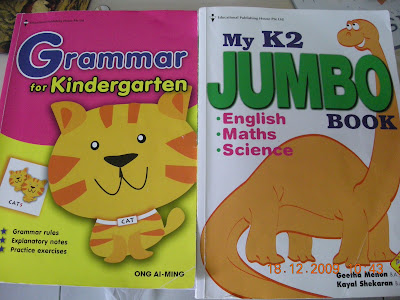
Let me show you a few snapshots of his work. The "Jumbo Book" contents include science, numbers, grammar, creative writing, vocabulary etc. I won't reproduce too much here but show you a few pages that I like best to let you have a feel of how it looks like.


I like my son's work on creative writing. I am amazed by his ability to write sentences together to form a paragraph.


I admit that sometimes my son is reluctant to do the worksheets. He hates creative writing because he usually does not know what to write. The trick to overcome this is that I let him do less worksheets, and I always keep the time short. The stickers and the praises/encouragements that I gave also played an important role.
My son was going to attend primary school then. Realizing that, he volunteered to go extra miles to complete all his English related worksheets. I did not think that he could complete those worksheet last year, but he did.
Thanks to all the materials he did and the kindergarten's teacher, I am confident that my son would be able to cope with English language when he is in primary one in 2010.
P/S :
1) I can send you the progress sheets (Nursery, K1 and K2 for Jumbo Book) that I created if you want. Just let me know.
2) I wrote part of this in 2009.
Most of the time, my son likes to do worksheets. He understands that he learns something. I can see that he enjoys learning. I have made it clear to my son that everyone has "work" to be done. If he wants to play with his other toys, he must do 20 minutes of "work". To me, the goal is achieved when he does the worksheet. I seldom correct or check his work because my intention is to cultivate a habit in him to do the worksheets, and I learned that correcting his mistakes in a wrong way may discourage him.

I did not pay much attention on which books he should work on. I selected "Jumbo Book" because that was the only Singapore Syllabus worksheet available to me when I was in Malayisa. Someone told me that this was a Singapore textbook. You should be able to find this in major Popular Bookstores (but not every Popular Bookstore has it). In Penang, you can find this in Popular Gurney Plaza and perhaps Queensbay Mall. Please call up to make inquiry before you make the trip.
To state the fact right, most Singapore kindergartens do not use text book and it's wrong to think that Jumbo Book is a text book for Singapore kindergartens. I bought the Grammar book later as it is specifically fine tuned to improve skills on grammar. By the way, over 2.5years, my son has completed 4 Jumbo Books - nursery, K1 and K2 levels (for the ages of 4, 5 and 6 respectively), plus the Grammar worksheet.

Let me show you a few snapshots of his work. The "Jumbo Book" contents include science, numbers, grammar, creative writing, vocabulary etc. I won't reproduce too much here but show you a few pages that I like best to let you have a feel of how it looks like.


I like my son's work on creative writing. I am amazed by his ability to write sentences together to form a paragraph.


I admit that sometimes my son is reluctant to do the worksheets. He hates creative writing because he usually does not know what to write. The trick to overcome this is that I let him do less worksheets, and I always keep the time short. The stickers and the praises/encouragements that I gave also played an important role.
My son was going to attend primary school then. Realizing that, he volunteered to go extra miles to complete all his English related worksheets. I did not think that he could complete those worksheet last year, but he did.
Thanks to all the materials he did and the kindergarten's teacher, I am confident that my son would be able to cope with English language when he is in primary one in 2010.
P/S :
1) I can send you the progress sheets (Nursery, K1 and K2 for Jumbo Book) that I created if you want. Just let me know.
2) I wrote part of this in 2009.
Tuesday, November 24, 2009
Report Card
Is report card a toy? No, definitely it's not. However, getting report card can be a pleasant experience for our children. Please allow me to share my son's report card and my observation on how a report card should be.
Report cards in my perception before I came to Singapore, even for kindergarten children, is full of 'A', 'B', 'C' etc. Check this out... you will like this.

You can see that there's no 'A', 'B', 'C' here, but the report card lists down good behaviors that a child should do. Then it grades them by whether they practice the good behavior "often", "sometimes" or "not yet". For example, one goal here is "I know how to read some sentence with understanding", in June, my son could do that "sometimes", but towards end of the year, he did that "often".
Getting the grade "Sometimes" tell parents that our child needs more encouragement. Even if you get a "Not Yet", seeing these words, the thinking is seldom negative. If you get 'C' or 'B', what do you think the parents would think? Or if you see others get an 'A' while you are getting a 'B'?

You can see the break downs of the skill sets even under category "listening". The teacher will also give comments on her observations. Instead of listening 'B', you find "I know how to follow oral instructions", "I can listen and respond to questions"... plus a comment on how my son did in this area.

Check this portion out, rather than merely looking at the result, the report cards also emphasizes on "Approaches to learning" and "Interaction between children".

This is a portion on Mathematics...

and Motor Skills portions... like this?
What do you think? I really feel thankful to the school and the teachers. This report card makes me think about the report cards I saw in Penang. At that time, my first question was, "What does 'A' or 'B' mean?" Naturally, seeing a 'B' on areport card, I asked the teacher, "What did the other kids get? Are they getting 'A' for subjects that my son is getting a 'B'"?
There is no way to run away from the standard report cards that we used to get. The grading of 'A', 'B', 'C' or even marks, average, position in class etc will come some days. But I think at kindergarten stage, the young ones should enjoy learning and not facing pressure due to comparison from "kiasu" parents.
I recommend the following guide. I think it's a must read for parents, if you are getting a report card from your child soon.
Report Card Guide by Slyvan Learning Center
I really feel thankful to all the teachers who had taught my son (Teacher Atika, Teacher Giam from My First School, and also Teacher Michelle, Teacher Oon, Teacher Loh in SuperKids). I do not know how he does compared to his classmates. That does not matter now. He can read story books, he can write some sentences, he can count, what else can I ask for? Thinking back, may be I had been too kiasu to purchase "worksheets" and ask him to do at home for 30 minutes before he plays.

"Well done! YK, you made me proud. Keep it up! YK".
I think kindergarten should not give any exams at all. And their report card and assessment should look like what I have shown. What do you think?
P/S
By the way, why do so many kindergartens in Penang (may be Malaysia) introduce exams and spelling test at the young tender age of 4-5 years old? I think the answer can be found if you ask the top kindergartens "M" and "D" in Penang.
Report cards in my perception before I came to Singapore, even for kindergarten children, is full of 'A', 'B', 'C' etc. Check this out... you will like this.

You can see that there's no 'A', 'B', 'C' here, but the report card lists down good behaviors that a child should do. Then it grades them by whether they practice the good behavior "often", "sometimes" or "not yet". For example, one goal here is "I know how to read some sentence with understanding", in June, my son could do that "sometimes", but towards end of the year, he did that "often".
Getting the grade "Sometimes" tell parents that our child needs more encouragement. Even if you get a "Not Yet", seeing these words, the thinking is seldom negative. If you get 'C' or 'B', what do you think the parents would think? Or if you see others get an 'A' while you are getting a 'B'?

You can see the break downs of the skill sets even under category "listening". The teacher will also give comments on her observations. Instead of listening 'B', you find "I know how to follow oral instructions", "I can listen and respond to questions"... plus a comment on how my son did in this area.

Check this portion out, rather than merely looking at the result, the report cards also emphasizes on "Approaches to learning" and "Interaction between children".

This is a portion on Mathematics...

and Motor Skills portions... like this?
What do you think? I really feel thankful to the school and the teachers. This report card makes me think about the report cards I saw in Penang. At that time, my first question was, "What does 'A' or 'B' mean?" Naturally, seeing a 'B' on areport card, I asked the teacher, "What did the other kids get? Are they getting 'A' for subjects that my son is getting a 'B'"?
There is no way to run away from the standard report cards that we used to get. The grading of 'A', 'B', 'C' or even marks, average, position in class etc will come some days. But I think at kindergarten stage, the young ones should enjoy learning and not facing pressure due to comparison from "kiasu" parents.
I recommend the following guide. I think it's a must read for parents, if you are getting a report card from your child soon.
Report Card Guide by Slyvan Learning Center
I really feel thankful to all the teachers who had taught my son (Teacher Atika, Teacher Giam from My First School, and also Teacher Michelle, Teacher Oon, Teacher Loh in SuperKids). I do not know how he does compared to his classmates. That does not matter now. He can read story books, he can write some sentences, he can count, what else can I ask for? Thinking back, may be I had been too kiasu to purchase "worksheets" and ask him to do at home for 30 minutes before he plays.

"Well done! YK, you made me proud. Keep it up! YK".
I think kindergarten should not give any exams at all. And their report card and assessment should look like what I have shown. What do you think?
P/S
By the way, why do so many kindergartens in Penang (may be Malaysia) introduce exams and spelling test at the young tender age of 4-5 years old? I think the answer can be found if you ask the top kindergartens "M" and "D" in Penang.
Subscribe to:
Posts (Atom)